Admission Requirements
Undergraduate Admissions Requirements
-
Completed application
-
Official transcripts
-
Letter of recommendation
-
Official SAT and/or ACT test scores (Marywood is test optional)
-
Essay (optional)
Facilities & Technology
Learning Commons
The Learning Commons changes minds about what a library is, how it works, and what it's supposed to do. By seamlessly navigating the ever-changing learning landscape, The Learning Commons in effect removes previous barriers to knowledge creation. Since it is far more than a repository for information, the facility instantly became a place where people collaborate and create knowledge, using the latest technology and the energy that is borne of intellectual exchange and inspirational spaces.
Center for Multimedia Communication
Located in the Learning Commons, the Center for Multimedia Communication provides media tools necessary to publish an online newspaper; direct, product, shoot, or edit video and audio programming; create and publish a PR newsletter; work as on-air television or radio talent; create virtual sets; produce short films; manage social media accounts; broadcast live sporting events; and much more. Marywood's Multimedia Communication students start getting valuable experience from Day One, learning how to become versatile, ethical, and in-demand communicators.
Radio Station 91.7 VMFM
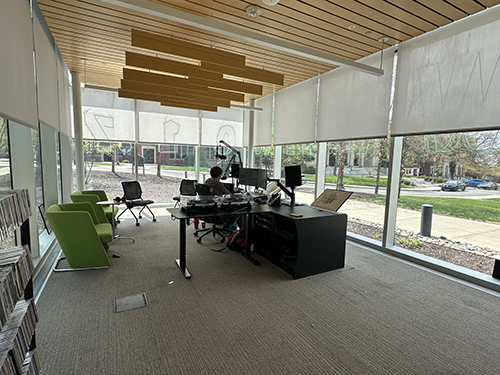
VMFM 91.7 is Marywood University’s student-run radio station, located in Marywood University's Learning Commons on the Terrace Level. VMFM is on air 24/7 and also streams online. The station operates at a frequency of 91.7 MHz and an operating power of 1.8KW.
For nearly two decades, VMFM has been named “Best College Radio Station" in the area and is only commercial-free alternative radio station in northeast Pennsylvania. The massive alternative catalog spans five decades and contains over 10,000 songs. Student disc jockeys also create their own specialized programming spanning a variety of genres.
TV-Marywood
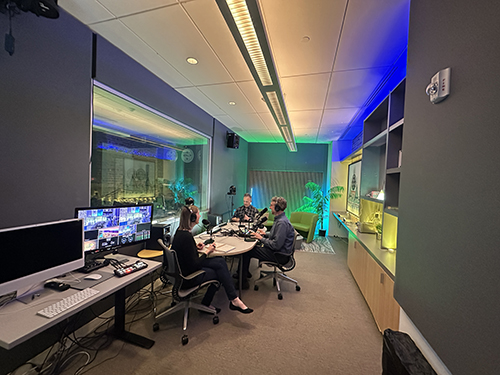
The TV Studio supports education and co-curricular activities in TV and film production. The TV Studio and in-field equipment also support TV-Marywood, Marywood's student-run television station, which is part of the Center for Multimedia Communication on the ground floor of the Learning Commons. TV-Marywood is distributed by Comcast and Facebook; department programming reaches 100,000+ households.
At the center of the TV production facility is a TriCaster8000 Switcher. It is supported by High Definition studio and field cameras and digital audio software. The space doubles as a classroom, where all studio production courses take place.
Students work as on-air talent and reporters and also assume other management and production positions. First-year students start working at TV-Marywood from Day One.
Podcast Studio
The Podcast Studio within the Multimedia Communication Department is a dedicated, professional space designed to support high-quality audio production, storytelling, and digital content creation. Equipped with industry-standard microphones, soundproofing, mixing consoles, and editing software, the studio provides students with hands-on experience in podcasting, voice recording, and audio post-production. It serves as both a learning environment and a creative hub where students can develop technical skills, experiment with narrative formats, and produce content for academic, personal, or public audiences. The studio also encourages collaboration across disciplines, fostering innovation in media communication while preparing students for careers in broadcasting, journalism, and digital media production.
Learning Commons Computer Labs
Computer labs and technology-rich spaces are available on every floor the Learning Commons. View the Building Guide to find out where Computer Labs are located.
Scholarships
Morris K. Udall Scholarship
The Udall Foundation seeks future leaders across a wide spectrum of environmental fields, including policy, engineering, science, education, urban planning and renewal, business, health, justice, and economics. The Foundation also seeks future Native American and Alaska Native leaders in public and community health care, tribal government, and public policy affecting Native American communities, including land and resource management, economic development, and education.
Faculty
Dr. Lindsey L Wotanis
Director of the School of Communication | Associate Professor
Frank W Carey
Music Therapy Clinical Field Supervisor | Lecturer
James Donnelly
Assistant Coordinator of Broadcast Operations (10 Mnth)
George D Graham
Chief Engineer
Alicia Grega
Lecturer | Lecturer
Sarah A Hall
Lecturer
Christina S Hitchcock
Lecturer
Adam J Marco
Lecturer
Brian D McGurl
Lecturer
Ernest D Mengoni
Director of Broadcast Operations
Cheryl A Mozdian
Music Therapy Clinical Field Supervisor | Lecturer
William N Murphy
Assistant Professor of Practice
Sujata Nair-Mulloth
Lecturer
Mandy Leigh Pennington
Lecturer
Kimberly Anne Petro
Lecturer
Rebecca E Pieper-Bohun
Lecturer
Sarah A Radzieski
Music Therapy Clinical Field Supervisor | Lecturer
Lindsay N Roth
Lecturer
Courses & Curriculum (120 Total Credits)
|
Course Numbers
|
Course Names
|
Credit Hours
|
|---|---|---|
|
Required for ALL MultiComm Students
|
|
33 Credits Total
|
|
COMM 103
|
Studio Production
|
3
|
|
COMM 104
|
Field Production and Editing
|
3
|
|
COMM 105
|
Audio Production
|
3
|
|
COMM 120
|
Introduction to Media Writing
|
3
|
|
COMM 200
|
Media, Culture, and Society
|
3
|
|
COMM 215
|
Media Performance
|
3
|
|
COMM 315
|
Visual Communication
|
3
|
|
COMM 336
|
TV News Production
|
3
|
|
COMM 415
|
Communication Ethics and Law
|
3
|
|
ENGL 440
|
Creating Digital Content
|
3
|
|
COMM 490
|
Multimedia Communication Capstone
|
3
|
|
Practicum
|
|
6 Credits Total
|
|
COMM
|
170A, B, or C
|
1 credit
|
|
COMM
|
171A, B, or C
|
1 credit
|
|
COMM
|
270A, B, or C
|
1 credit
|
|
COMM
|
271A, B, or C
|
1 credit
|
|
COMM
|
370A, B, or C
|
1 credit
|
|
COMM
|
371A, B, or C
|
1 credit
|
|
Journalism Required Courses
|
|
15 Credits Total
|
|
COMM 220
|
Advanced Media Writing
|
3
|
|
COMM 322
|
Copy Editing
|
3
|
|
COMM 420
|
Multimedia Features
|
3
|
|
COMM elective
|
|
3
|
|
COMM elective
|
|
3
|
|
COMM 220
|
Advanced Media Writing
|
3
|
|
COMM 322
|
Copy Editing
|
3
|
Students may take one (1) additional practicum as an elective (7 credits total). Additional credits may be taken with the approval of the program coordinator and the chairperson. All students, including transfer students, must take six (6) practica. An internship may be substituted for three (3) credits with the approval of the program coordinator and the chairperson.
Program Learning Outcomes
Students are prepared for careers in the ever-changing journalism and public relations fields, which includes producing content for a variety of platforms including print, broadcast, digital and social. Students gain practical and theoretical skills, knowledge and ethics applicable to finding, reporting, writing, editing, and producing news and public information using traditional as well as new and emerging media. These include print, television and radio, as well as social media and web-based platforms. Students acquire leadership and management skills working at the student-managed online news outlet and television station.
Student Resources
Multimedia Communication Laptop Policy
|
Component
|
Windows recommended
|
Mac recommended
|
|---|---|---|
|
Operating system
|
Windows 11, 64-bit
|
Current supported macOS
|
|
Processor
|
Intel Core i7/i9 or AMD Ryzen 7/9, current generation
|
Apple M4, or newer; Pro-level chip preferred
|
|
Memory
|
32 GB RAM
|
24–32 GB unified memory preferred; 32 GB ideal
|
|
Storage
|
1 TB SSD
|
1 TB SSD
|
|
Graphics
|
NVIDIA RTX or comparable dedicated GPU with 6–8 GB VRAM or higher
|
Apple Silicon GPU; Pro-level chip preferred for heavier video work
|
|
Display
|
14–16 inch display; high color accuracy preferred
|
14–16 inch MacBook Pro preferred for heavier production work
|
|
External storage
|
1–2 TB external SSD for media projects
|
1–2 TB external SSD for media projects
|
|
Warranty
|
3–4 year accidental damage/support plan recommended
|
AppleCare+ recommended
|
From #DayOne, Marywood is here for you each step of the way.