My time in Marywood’s Interior Architecture program taught me how to take control of my future given the opportunities at hand. One such opportunity was helping to lau...
The four-year, Interior Architecture degree at Marywood University prepares students to design dynamic interior environments for adaptive reuse, renovation, and new construction projects. This professional interior design program is the only BIA program in Northeast Pennsylvania accredited by National Association of Schools of Art and Design (NASAD).
As one of the most forward-thinking colleges in the region, Marywood offers a unique blend of creative freedom, technical training, and sustainability-focused design education. Students learn to craft spaces that elevate function, form, and well-being — from residential interiors to commercial, institutional, and cultural environments.
Marywood also holds a prestigious Zero Energy Design Designation (ZEDD) from the U.S. Department of Energy — demonstrating its commitment to environmentally responsible design education at the undergraduate level.
To become a licensed interior architect, most states require an accredited degree, experience hours, and passing the National Council for Interior Design Qualification (NCIDQ) exams, administered by the Council for Interior Design Qualification (CIDQ). The BIA program fulfills the first and most essential requirement.
Students who complete the BIA program are eligible for 41 credits of advanced standing in the Master of Architecture or Master of Interior Architecture program. This makes it easy to deepen expertise in sustainable interiors and integrated design strategy.
Focused on developing the skills needed to design thoughtful interiors, buildings, and spatial environments, this accredited interior architecture degree trains students to create the specific character of spaces for human use and enjoyment. Interior architects learn how materials, colors, textures, and light influence human experience — and how to design spaces that respond to physical, psychological, and cultural needs.
Interior Architecture students benefit from a professional curriculum that includes:
Eight sequential semesters of design studios , steadily growing in complexity from beginning studio to a comprehensive interior design project
Building science courses covering building systems, environmental science, and renewable energy sources
Hybrid representation courses , with hands-on training in animation, digital and physical model making, digital rendering, fabrication, and hand drawing
History and theory courses exploring the diverse cultural and social influences that shape the built environment
Program electives in topics like furniture design, lighting, and urban ecologies
A required semester abroad in Florence, Italy
Students also benefit from shared coursework with peers in Architecture, Construction Management, and Virtual Architecture — helping them build a collaborative, real-world design mindset.

Live and learn within one of the world's most significant cultural environments—Florence! The Marywood University International: Florence offers students the opportunity to advance their academic studies through immersive international education in one of the world's most historically and culturally significant cities.
From June 20 to June 27, 2026, students are invited to explore the world of interior architecture through Marywood’s Design Your Future Program, an immersive eight-day experience filled with creative design challenges, studio sessions, firm tours, and workshops.
This is a valuable opportunity for high school who want to preview life in an School of Architecture program — especially those considering an
interior architecture degree
focused on addressing the most urgent design challenges of our time.
Interior Architecture courses are taught in a LEED Gold-certified facility equipped with rainwater harvesting, geothermal cooling, and a green roof — a living example of sustainable, adaptive reuse design. Students gain hands-on experience with the tools and technologies that drive today’s design industry.
Marywood interior architecture students have been recognized for their creative achievements, including the Gravity Slope Colliery adaptive reuse project, which was nominated for a SAGE Award from the Greater Scranton Chamber of Commerce.
Students also showcase their work at First Friday Gallery nights in downtown Scranton and during the Observe Scranton Festival, presented in partnership with the Center for the Living City.
Students and faculty frequently partner with industry-leading firms and organizations, including:
Fancy Parsley
HC Architects
Sordoni Construction Services
And with regional nonprofits and museums such as:
Black Scranton Project for Arts and Culture
Electric City Trolley Museum
Everhart Museum
Lackawanna Historical Society
United Neighborhood Center of Northeast Pennsylvania
With a strong focus on career development, Marywood hosts an annual career fair and supports students through internships, mentoring, and portfolio reviews. The program reports an 85% job placement rate in professional roles.

My time in Marywood’s Interior Architecture program taught me how to take control of my future given the opportunities at hand. One such opportunity was helping to lau...
Undergraduate Admissions Requirements
Completed application
Official transcripts
Morris K. Udall Scholarship
The Udall Foundation seeks future leaders across a wide spectrum of environmental fields, including policy, engineering, science, education, urban planning and renewal, business, health, justice, and economics. The Foundation also seeks future Native American and Alaska Native leaders in public and community health care, tribal government, and public policy affecting Native American communities, including land and resource management, economic development, and education.
The four-year, professional Bachelor of Interior Architecture (BIA) degree program at Marywood is accredited by the National Association of Schools of Art and Design (NASAD). Marywood offers advanced standing in their professional Master of Interior Architecture (MIA) program for students with undergraduate degrees in Architecture, Interior Architecture, Virtual Architecture, or Construction Management. To become a licensed interior architect/designer, most states require completion of an accredited degree, Experience hours and NCIDQ exams administered by the Council for Interior Design Qualification (CIDQ).
The Bachelor of Interior Architecture degree program requires study abroad in the third year in Florence. Students with extenuating circumstances outlined in the MU SOA Study Abroad Policy may apply for an exemption.
A minimum grade of “C” is required in order to fulfill the University’s requirement of design competency in each of the following studio courses: ARCH 110 , ARCH 120 , ARCH 210 , IARC 220A , IARC 310A , IARC 320A , IARC 410A , and IARC 420A .
Total of 120 credits required including:
Core curriculum*
Interior Architecture curriculum
General Electives
The Interior Architecture curriculum is scaffolded by four curricular sequences listed below. Please email the MU SOA Director at architecture@marywood.edu for a recommended, semester-by-semester curriculum tracker outlining the four-year program.
|
ARCH 110 |
Design Studio I |
4 |
|
ARCH 120 |
Design Studio II |
4 |
|
ARCH 210 |
Design Studio III |
6 |
|
IARC 220A |
Interior Architecture Studio IV |
6 |
|
IARC 310A |
Interior Architecture Studio V |
6 |
|
IARC 320A |
Interior Architecture Studio VI |
6 |
|
IARC 410A |
Interior Architecture Studio VII |
6 |
|
IARC 420A |
Interior Architecture Studio VIII |
6 |
|
IARC 111L |
Hybrid Representation Lab I |
2 |
|
IARC 121L |
Hybrid Representation Lab II |
2 |
|
IARC 211L |
Hybrid Representation Lab III |
2 |
|
ARCH 127 |
Building Technologies I |
3 |
|
ARCH 217 |
Building Technologies II |
3 |
|
ARCH 227 |
Building Technologies III |
3 |
|
ARCH 317 |
Building Technologies IV |
3 |
|
ARCH 417 |
Building Technologies V |
3 |
|
ARCH 128 |
Hist & Thry of Arch & Interior Arch I |
3 |
|
ARCH 218 |
Hist & Thry of Arch & Interior Arch II |
3 |
|
ARCH 228 |
Hist & Thry of Arch & Interior Arch III |
3 |
Total Credit Hours: 131
Additional Courses
ARCH 462 (Professional Practice), Program Electives (9 credits)**, and General Electives (3 credits).
* ART 218, MATH 160, and PHYS 140 are recommended to fulfill Core requirements for Bachelor of Interior Architecture students. Equivalent or higher courses will be accepted on a case-by-case basis.
** Program Electives shall be selected from Interior Architecture, Architecture, Virtual Architecture, Construction Management, and other courses approved by the MU SOA Director. Program Electives shall not be otherwise required courses in the Bachelor of Interior Architecture degree program.
Interior Architecture Student Work
From #DayOne, Marywood is here for you each step of the way.
In some cases, where students learn can be as important as what they learn. Where it can be a modern urban center or a historic city like Florence, or it can be a building so innovative in its design that it becomes a partner in the educational experience. Such is the case with Marywood’s Center for Architectural Studies, which houses the School of Architecture.
The School of Architecture is a state-of-the-art example of sustainable design. It's a spacious, adaptive re-use of Marywood's former gymnasium and natatorium. It features:
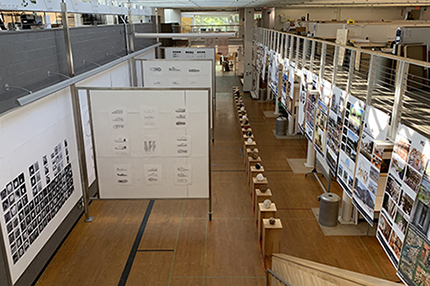
A two-story commons under a continuous skylight harvests abundant natural light throughout the day and serves as the building's "agora" - an open, shared, central space for educational exchanges among students and faculty. This is an ideal place for group discussions, debates, displays, and project critiques.
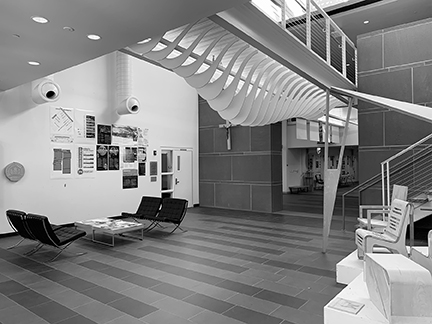 Entrance to the building with student work displayed
A two-story commons under a continuous skylight harvests abundant natural light throughout the day and serves as the building's "agora" - an open, shared, central space for educational exchanges among students and faculty. This is an ideal place for group discussions, debates, displays, and project critiques.
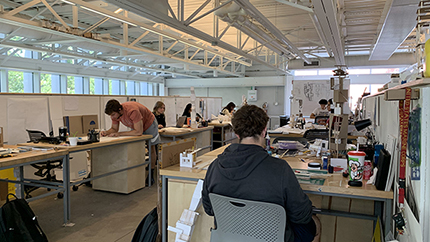
Every student is provided an individual work space with a drawing board, personal storage area, pin-up wall, and space for a laptop.
It features:
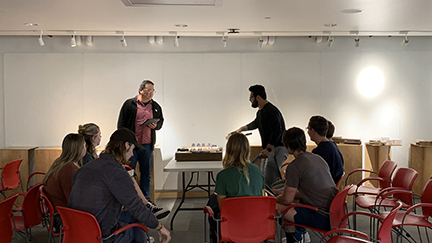
The Cloud Room (CAS 251) is located on the second level of the Center for Architectural Studies, above the lobby. Including only chairs without desks, it is not considered a traditional classroom space. The Cloud Room is used by the School of Architecture as a meeting space and as a location for architecture lectures and guest speakers.
Director, School of Architecture | Associate Professor
Administrative Lead | Study Abroad Coordinator
Associate Director of Graduate Studies | Assistant Professor
Associate Professor | Associate Director of Undergraduate Studies
Assistant Professor of Practice
Associate Professor
Instructor of Practice
Assistant Professor of Practice
Lecturer
Professor
Lecturer
Lecturer
Lecturer
Lecturer
Lecturer
Lecturer
Shop Manager/Technician
Instructor
Lecturer
Lecturer
Digital Output Technician
Lecturer
Assistant Professor
Instructor of Practice
Lecturer
Lecturer
Work Study Students | Lecturer
Associate Professor
Construction Management Program Director | Assistant Professor
Assistant Professor of Practice
Lecturer
Lecturer
Assistant Professor
Lecturer
Lecturer
Lecturer
Professor
Lecturer
Lecturer
Lecturer
Explore the vibrant community and endless opportunities that await you at Marywood. Attend one of our special events designed specially for you to learn more about Marywood's degree programs, dedicated faculty, and welcoming campus.
Campus Visits »Marywood University hosts three academic Centers of Excellence on campus; The Center for Law, Justice and Policy, The Center for Urban Studies, and The Mother Theresa Maxis, IHM Center. Each center provides students with the tools and resources to excel in their academic endeavors, fostering a dynamic environment where they can engage deeply with their respective fields of study and make meaningful contributions to their communities and beyond.
Marywood University is accredited by the Middle States Commission on Higher Education (MSHE).
Art and design programs at Marywood University, including the Bachelor of Interior Architecture (BIA) , are accredited by the National Association of Schools of Art and Design (NASAD). With experience hours, our graduates are eligible to take the National Council for Interior Design Qualification (NCIDQ) exam.
Pennsylvania has enacted legislation (Act 144 of 2024/SB 1319) that establishes a voluntary "Certified Interior Designer" (CID) title for qualified professionals. This law protects the title, allowing those with specific education, experience, and passing the NCIDQ exam to register with the state. View more information about interior design licensure in the US »
Info For: