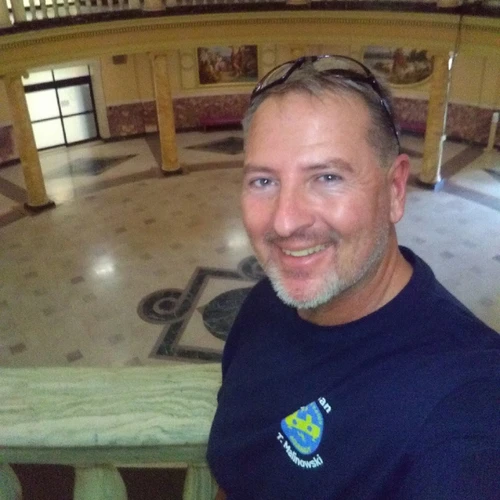
Trace Malinowski
From Marywood to the Deep: Trace Malinowski’s Journey in Diving, Education, and Leadership
For Trace Malinowski, a 1993 Marywood University graduate with a bachelor’s degree in English, an unexpected detour on his path to college became the beginning of a remarkable career. Today, Trace serves as president of the National Independent Divers Association (NIDA), where he brings decades of experience in scuba instruction, diving safety, and industry leadership to an organization dedicated to advancing diver education. From teaching students to explore underwater caves to helping shape international diving standards, Trace’s journey reflects the value of curiosity, perseverance, and the courage to pursue an unconventional path.
Trace’s connection to Marywood began before he ever stepped into a college classroom. His mother had taught in the University’s Education Department since the 1960s and was serving as Director of Field Experience and Student Teaching when he first enrolled in 1986. With tuition benefits making Marywood an affordable choice, Trace decided to enroll, though he initially planned on enlisting in the Army to become a paratrooper. Three months into his first semester, he dropped out to pursue that goal, but he soon realized he had passed up a valuable opportunity.
When he returned in 1988 as a probationary student, Trace approached his education with a new perspective. He retook the courses he had previously failed and went on to make the Dean’s List every semester from 1988 through his graduation in 1993. As he explains, “I loved the campus, the professors, and my fellow students and the energy and excitement everyone brought to the classroom.”
One professor who left a lasting impression was Dr. John W. Barrett, who taught Trace’s first college course, Roots of the Modern World. Trace remembers being struck by Dr. Barrett’s deep knowledge of history, engaging lectures, and demanding exams, which challenged students to think beyond memorization and make connections across historical events and global issues. For Trace, the experience marked a significant shift from high school expectations to the rigor of college-level learning. Dr. Barrett, he recalls, “set the standard for what was expected of us academically.”
Trace’s experience at Marywood also demonstrated the value of learning in a close-knit academic community. While friends at larger universities described crowded lecture halls and limited interactions with professors, Trace found opportunities to build meaningful relationships with faculty members both inside and outside the classroom. He enjoyed sharing meals and coffee with professors, working out alongside them, and having conversations around campus.
Reflecting on those connections, Trace explains, “Being on a small campus allowed me to be somebody instead of a nobody.” He believes the relationships he developed at Marywood helped him feel included, encouraged him to participate in campus life, and gave him the confidence to contribute his own ideas.
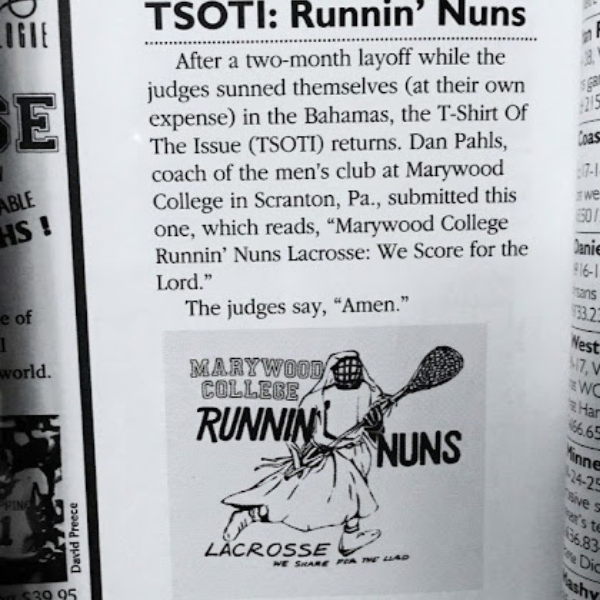
Outside the classroom, Trace stayed active in a variety of student organizations and activities, including lacrosse, flag football, the Scriblerus Club, and the Men’s Weightlifting Club. He also participated in Lambda Iota Tau, Theta Alpha Kappa, and Delta Epsilon Sigma activities. One especially memorable experience was playing attack on Marywood’s first men’s lacrosse team in the early 1990s. Known as the “Runnin’ Nuns,” the club team even had its T-shirt selected as one of the top six T-shirts of the year by Lacrosse Magazine. Trace had never held a lacrosse stick before joining the team, but he eventually became its second-leading goal scorer.
An opportunity to take a lifeguarding course for physical education credit in 1988 would prove equally influential, introducing Trace to a field that would shape his professional life. Just a year later, he became a scuba instructor, beginning a career that took him from England and the Caribbean to the St. Lawrence River, Florida, and Southern California. Over the years, he taught divers at every level, from beginners learning basic skills to experienced divers exploring challenging underwater cave systems.
After graduating from Marywood in 1993, Trace combined his interests in education, communication, and diving to build a multifaceted career. In addition to teaching, he wrote diving manuals and articles for American Lifeguard Magazine. He also explored creative writing, publishing the romance novel The Amphitrite Entanglement under the pen name Coral Lee Tide. His professional experiences eventually led him into technical diving leadership, scientific diving, and the development of training programs designed to promote safety and professionalism throughout the industry.
From living submerged as an Aquanaut at Jules’ Undersea Lab to volunteering as a Rescue/Recovery Surface Operations Manager and First Responder Rescue/Recovery Diver for International Underwater Cave Rescue & Recovery (IUCRR), Trace’s career has been defined by operating in extreme environments. Yet, among all his achievements, he considers his appointment to the Board of Directors for both the Recreational Scuba Training Council (RSTC) and the World Recreational Scuba Training Council (WRSTC) from 2007 to 2011 to be his proudest professional milestone. As the governing bodies responsible for setting unified minimum safety and ISO standards worldwide, serving on these international boards allowed Trace to translate his real-world, high-risk expertise into shaping global diving policy and education.
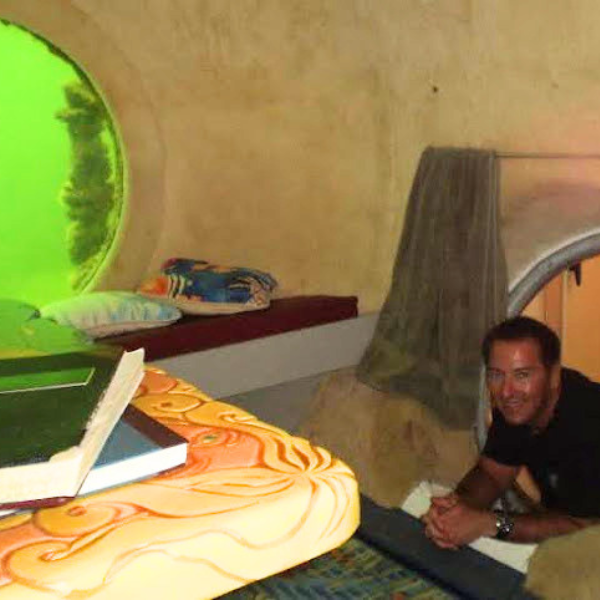
Trace reflects, “It’s difficult to say what is more profound: waking up five fathoms deep, with fish looking into your bedroom, or waking up knowing the standard you fought for in the boardroom may very well keep a fellow diver from ‘sleeping with the fishes.’”
Today, Trace continues that work as president of the National Independent Divers Association, an organization he formed to advance diver training, with a focus on solo diving. His professional journey has included its share of challenges, including surviving decompression sickness, commonly known as the bends, in 2018. Yet his passion for the water and for helping others learn has remained constant. After working in snowmaking at Jack Frost, he returned to lifeguarding and even worked as an ocean lifeguard in Ocean Ridge, Florida, at age 57. He continues to teach scuba diving and pursue new ways to improve the profession.
Trace credits his Marywood education with helping him develop the perspective and confidence necessary to question established practices, communicate ideas, and seek solutions. His English degree, complemented by minors in Philosophy and Religious Studies, taught him to consider the human condition from multiple perspectives. As he explains, “People are shaped by their stories, their ideas, their beliefs, and their relationship with the divine.”
That understanding continues to influence his approach to teaching. Trace strives to recognize the individual experiences and perspectives each student brings to a course, believing that effective instruction involves more than technical knowledge. One of his cave-diving students even told him that the leadership principles learned during Trace’s class helped him become a better husband and father.
For Trace, Marywood’s influence extends beyond academics and professional preparation. The University helped him understand that he could make a difference by asking questions, examining accepted practices, and having the courage to speak up. He believes those lessons have been especially important in his work identifying opportunities to improve diving safety and developing new approaches to diver education.
His passion for the natural world also continues to guide his interests outside of diving. From lifeguarding beaches and exploring underwater reefs, wrecks, and caves to working on mountain slopes as a ski resort snowmaker, Trace has built a life around the outdoors. Today, he is particularly concerned about the expansion of data centers and their potential effects on natural landscapes, including places such as Lake Tahoe, Archbald, and his hometown of Gouldsboro in the Poconos. He hopes to encourage others to become more involved in protecting the places that make the natural world worth exploring.
Looking back on higher education since his graduation, Trace hopes colleges and universities continue to foster the kind of open, civil debate he remembers from Marywood. Drawing on his Philosophy studies, he emphasizes the importance of questioning ideas and considering different perspectives. For him, education should create opportunities for thoughtful disagreement and meaningful discussion rather than discourage students from expressing themselves.
His advice to current Marywood students reflects the lessons he has learned throughout his own journey: “Be brave. Don’t sacrifice learning for grades—take the challenging courses. Be yourself.” He encourages students to explore their interests, pursue their passions regardless of their majors, and build genuine relationships with the people around them. He also reminds them that some of life’s most meaningful opportunities come from taking chances and remaining open to unexpected experiences.
From returning to college after an early setback to helping shape international diving safety standards, Trace Malinowski’s story illustrates how a Marywood education can provide a foundation for a career that takes many unexpected turns. His journey is a testament to the importance of lifelong learning, personal resilience, and the willingness to challenge convention. Through his work in diving education and leadership, Trace continues to put those lessons into practice, encouraging others to think critically, pursue their passions, and make a difference in the world around them.